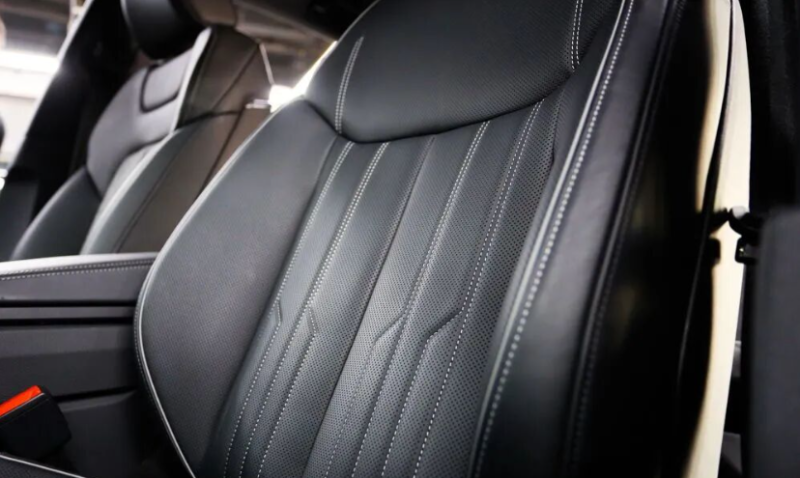


In automotive seat design, perforations are an important element in interior design and, in a sense, serve as a key signal of design trends. At present, hole design is no longer limited to conventional holes; large-area pattern positioning cycles or small flower pattern positioning cycles are gradually becoming trends. Whether domestic brands, joint ventures, or even those that use traditional design as a family symbol, they have begun seeking breakthroughs. Unconventional hole designs are constantly emerging, raising the requirements for PVC fabric characteristics and production processes, while improvements in PVC fabric formulations will continue to improve as designs evolve.
![Image [1]-How to Enable and Use the Auto Draft Feature in Your Content Management System to Improve Writing Workflow and SEO Performance-Nleather](https://www.nleather.com/wp-content/uploads/2026/06/image-54.png "image – Nleather")
After punching holes, PVC seat fabric must meet both design requirements and mechanical performance requirements. This paper tests the tensile strength and tear strength of a PVC fabric after conventional perforation design, and examines whether PVC fabric meets the test standards under various combinations of different pore diameters and spacings. Based on the results of this trial, corresponding conclusions were drawn and the problem of design failing to achieve mass production was avoided.
The perforated PVC fabric design for automotive seats, as an important element in seat design, can reflect the designer’s style intent in the overall vehicle design scheme. At the same time, it performs well in dynamic and static perception, such as visual perception, seat ventilation, leather feel and odor. With the continuous improvement of public aesthetics and the constant updating of automotive concepts, major automakers have been raising their standards for automotive aesthetics. Nowadays, when customers choose cars, design and styling have gradually become one of the key reference points for car purchases.
Seat design plays a key role in the overall interior styling of the car. Data shows that when observing an object, the most direct visual conveyance in the first 20 seconds is the combination of large color blocks; In the post-2020s visual experience, the attention to detail is especially highlighted, and the color blocks of the seats occupy the vast majority of the design. Therefore, during the early design process, the perforated leather fabric became one of the key factors in the chair’s exterior design.
Leather perforation design tests the mechanical properties of the leather itself and can also be called a “destructive process.” It tests whether, after punching holes, the leather can meet both design requirements and automotive specifications, as well as the mechanical performance requirements of automakers. To verify whether leather fabrics can meet enterprise standards and mechanical performance requirements without hole profiles, the authors of this paper base their routine hole design on the basis and arrange and combine them with hole diameter and hole spacing as variables. Mechanical performance tests on tensile strength and cut tear strength were conducted to verify whether different hole shape conditions met the standards, and a final conclusion was drawn.
Experimental materials
All PVC fabric samples used in this study are provided by the same supplier and employed by the same production process. PVC samples comply with formulas standardized by most companies on the market, with only changes in the perforation parameters.
Aperture diameter refers to the diameter of the hole; Hole spacing refers to the center distance between two holes, that is, the distance from the center of the first hole to the center of the second hole (Figure 1). To ensure that the test samples can cover more pore design schemes, the selection range for pore size and spacing is arranged and combined between conventional and unconventional conditions. Aperture Size Parameter Range: 0.7~1.4mm; Hole spacing range: 4.0~7.0mm.
(1) Conventional range: hole diameter is 0.9~1.2mm; Hole spacing is 5.0mm and 6.0mm.
(2) The unconventional range is divided into upper and lower limits. Upper aperture: 1.3mm, 1.4mm; upper hole pitch: 7.0mm; lower aperture diameter: 0.7mm and 0.8mm, lower hole pitch: 4.0mm.
There are two ways to select and combine aperture and hole spacing: arranging the same aperture size with different spacing, and arranging the same spacing with different apement sizes, resulting in a total of 32 combinations.
Test method
Tensile strength
Tensile strength refers to the maximum stress a material can withstand under tensile forces. In engineering design and material selection, tensile strength is a very important parameter, directly affecting the material’s service life and safety performance. Basis for tensile strength testing.
Tensile strength
Tensile strength refers to the maximum stress a material can withstand under tensile forces. In engineering design and material selection, tensile strength is a very important parameter, directly affecting the material’s service life and safety performance. Basis for tensile strength testing.
Tear strength at the incision
Cut tear strength refers to the maximum tensile force the material endures before breaking during the stretching process. It is an important metric for measuring the tear resistance of materials and is commonly used to assess the quality of flexible materials such as paper, fabric, and leather. Cut tear strength is based on ISO13937-2-2000 ‘Textiles.’ Fabric tear characteristics. Part 2: Measurement of Tear Strength of Pants-shaped Specimens (Single Tongue Method) for testing. The test parameters are as follows.
Stretching direction: perpendicular to the mechanical direction≥ 20N; Sample size: 50.0mm× 200.0mm. Take 3 samples each for longitudinal and transverse directions. Sampling is based on the fabric warp and weft directions, transverse parallel to weft, and longitudinal parallel to warp; Laboratory environment: ambient temperature is (22±3)°C, ambient 🗎 degree is (50±5)%RH; Test speed: stretched at 100.0mm/min until fracture; Cut requirements: Start from the center of width and make a longitudinal gap 100.0mm long. At the end of the final cut of the specimen, mark the tear end at 25.0mm to indicate the tear location at the end of the test
Experimental results and analysis
Experimental results of the same hole spacing but different diameters
Set the variable to keep the hole pitch unchanged and the aperture diameter increasing for testing. The test results for hole spacing of 0.7mm, 0.6mm, 0.5mm, and 0.4mm are shown in Tables 1~4.
Test data show that for PVC fabric with the same formula, the hole spacing and pore size remain unchanged
Increased from 0.7mm to 1.4mm. As the pore diameter increases, the tensile force experienced by PVC fabric decreases. According to the test standards, the minimum transverse and longitudinal bearing force after drilling is ≥ 200N. According to this statistics, data marked in red in Tables 1~4 are failed combinations. In other words, under the 7.0mm hole spacing condition, the pass rate reaches 100%; Under the 6.0mm hole spacing condition, except for the failure of the 1.3mm and 1.4mm hole combinations, the pass rate reaches 75%; while 5.0mm hole spacing has more failures, with a pass rate of only 25%; Under a 4.0mm hole spacing condition, all failures occur
Experimental results of tensile strength with the same pore diameter but different pore spacing
Set the variable to keep the aperture size unchanged and the hole pitch increasing for testing. The test results for hole diameters of 0.7mm, 0.8mm, 0.9mm, 1.0mm, 1.1mm, 1.2mm, 1.3mm, and 1.4mm are shown in Tables 5~12.
According to test data, the hole diameter of PVC fabric with the same formulation remains unchanged, with the hole spacing increasing from 4.0mm to 7.0mm. As the hole spacing increases, the tensile force experienced by the PVC fabric also increases. According to the test standards, the initial tensile force in both the transverse and longitudinal directions after drilling is ≥ 200N. Based on this, the data marked in red in Tables 5~12 are considered failed combinations. Statistics show that under 0.7mm and 0.8mm aperture conditions, the highest pass rate reaches 75%; The pass rate is 50% under aperture sizes of 0.9mm, 1.0mm, 1.1mm, and 1.2mm; Under 1.3mm and 1.4mm aperture conditions, the pass rate is only 25%.
Tear strength test results at the incision edge
Tear strength tests of different pore diameters were conducted under each hole spacing condition. The test results are shown in Table 13.
According to the cut tear strength test data, the pass rate of the test results is extremely high, reaching 90% among 32 data sets. The failed combinations were concentrated in the 4mm hole spacing, with aperture diameters of 1.2mm, 1.3mm, and 1.4mm respectively, and both the aperture and hole spacing were the maximum sampling values
Experimental conclusion
This paper conducts an experimental study on the impact of perforated design on mechanical properties of a certain chair’s PVC fabric, drawing the following conclusions.
(1) Hole spacing is a key factor affecting the pass rate of the perforated fabric’s tensile strength value. Test data show that under the same bore spacing combined range, pore diameter gradually increases from small to large, while the overall tensile strength data shows a decreasing trend. Qualified samples are concentrated in the combination range of 6.0mm and 7.0mm hole spacing, while the pass rate for 4.0mm and 5.0mm combinations is less than half. From this, it is clear that the size of the hole spacing is an important factor in determining whether the fabric meets the standards. Therefore, in practical design, the larger the hole spacing of PVC fabric drilling, the greater the tensile force it can withstand, and the higher the pass rate.
(2) In combinations of the same hole diameter but different hole spacing, the change in hole spacing gradually increases from small to large, and the tensile force test results also increase. The pass rate for hole diameters below 1.2mm can reach 50%. From this, it can be seen that as the hole spacing gradually increases, the fabric pass rate also gradually decreases. So, for the same hole diameter, the larger the hole spacing, the less tensile force the fabric can withstand. In other words, the larger the hole spacing, the greater the damage to the fabric surface, so the fabric’s ability to withstand tensile force decreases accordingly. However, in terms of pass rate, the size of the pore size does not play a decisive role in the fabric itself, and the value of the hole spacing remains an important factor affecting whether the fabric’s tensile strength meets standards.
(3) Test data show that the state trend of the fabric after the cut is similar to the tensile strength results. The factors affecting the tensile force value the fabric can withstand, similarly, the larger the hole spacing, the greater the tensile force; the larger the hole, the lower the tensile force. However, according to the above tear strength test results, the sample pass rate reached 90%, with only three sets of limit value combinations for unqualified samples. This indicates that in conventional perforation design combinations, the size of the hole diameter and hole spacing does not cause greater damage to the fabric after tearing or cutting.
(4) The hole type combinations used in this drilling test are all conventional circulating hole types. If non-cyclical combinations are encountered in design or large areas of floral patterns are presented through punching, it is necessary to select the part of the fabric with the largest hole diameter and the smallest hole spacing for sampling from the entire fabric perforation coverage area. The final result can cover the entire fabric.
Author: Wang Shuo, Wei Donglin, Yang Songlin, SAIC-GM-Wuling Automobile Co., Ltd., Liuzhou

No comments yet