
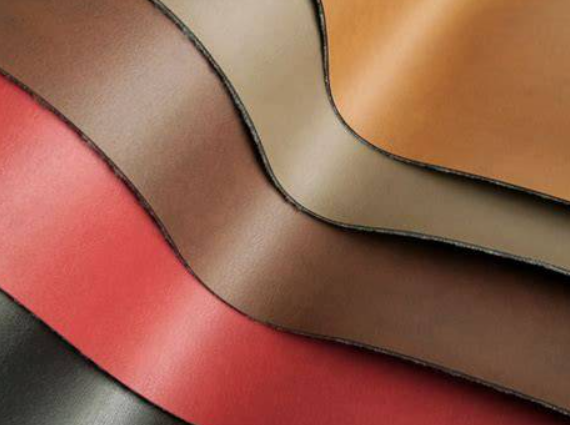
Microfiber combination finished leather (Referred to as microfiber leather) is a cutting-edge product in the field of synthetic leather, widely used in high-end footwear, automotive interiors, high-end bags, and apparel. Microfiber leather is made from ultra-fine nylon fibers (PA6 or PA66) forming a three-dimensional network framework, internally filled with polyurethane resin to form a biomimetic structure. Its tear strength, abrasion resistance, and feel are close to or even surpass natural leather. However, it is precisely this “two-component” structure (nylon fiber + polyurethane) that brings unique color-changing challenges—the two components have huge differences in dye affinity, which easily leads to issues such as “white core,” color spotting, and color migration. This paper starts from the microstructure of microfiber leather and systematically analyzes its color-changing process path and key technical points.
![Image [1]-Inside the Microfiber Color-Changing Process – Nleather-Nleather](https://www.nleather.com/wp-content/uploads/2026/07/20260712-111211-Zq8Ts-nleather-silicone-leather.png "20260712-111211-Zq8Ts-nleather-silicone-leather – Nleather")
Structural Features and Color Change Challenges of Microfiber Leather
The essence of microfiber leather is: A composite of island-type microfiber nonwoven fabric and polyurethane resin 。 Its nylon monofilament fineness is only 0.0001~0.001 denier, with a large specific surface area, extremely fast dye adsorption, and naturally poor uniformity; At the same time, the finer the fiber, the easier it is for internal dyes to migrate to the surface, resulting in poorer color fastness.
The core difficulties in the color change can be summarized as “three contradictions”:
| Contradictory type | Specific performance | Root cause analysis |
|---|---|---|
| Synchronization of two-component coloring | Nylon fibers and polyurethane resins have varying shades of color, and their surfaces are prone to ‘white frost’ | The two have significant affinity for dyes, and the uniformity of resin distribution directly affects the coloring effect |
| Balancing evenness and darkness | Fibers that are too fine cause poor dye uniformity, but pursuing dark colors requires a large amount of dye | The dye dosage is ideally 3%~4%; excessive amounts can actually affect fastness |
| The contradiction between dense structure and permeability | Base fabrics thicker than 1.3mm have dense structures that are difficult to dye through | Strengthening control over penetrants and dyeing processes is needed |
Color Change Material System
Dye Systems (Based on Dyeing Mechanisms)
Microfiber leather can be dyed with a variety of ionic and non-ionic dyes, with the key being matching the characteristics of the two components:
![Image [2]-Inside the Microfiber Color-Changing Process – Nleather-Nleather](https://www.nleather.com/wp-content/uploads/2026/07/20260712-111229-entQ7-nleather-silicone-leather.png "20260712-111229-entQ7-nleather-silicone-leather – Nleather")
Dyes suitable for nylon fibers :
Acid dyes : Through ionic bonding with the amino groups at the ends of nylon fibers, red and brown series have better bonding fastness, while yellow, purple, and black types have relatively poorer bonds, which is related to the number of hydrophilic groups in dye molecules
Neutral dye (Type 1:2 metal complexation dye) : By combining ionic bonds, hydrogen bonds, and van der Waals forces, it has better dyeing ability for deeper colors than acid dyes and excellent resistance to washing and sunlight, but its chromatographic is incomplete and the colors are not vivid
Reactive dyes : Can form covalent bonds with fibers, but polyamide fibers have limited amino groups, low color yield, and poor dyeing quality
Suitable for dyes on polyurethane resins :
Disperse dyes : Hydrophobic nonionic dyes form hydrogen bonds and van der Waals forces with amide groups in PU molecules, making them the main dye type for dyeing PU resins, with large dyeing volumes and good color fastness
Direct dyes : High molecular weight, difficult to penetrate deep into fibers, prone to ring dyeing and white core, poor fastness, generally not suitable for base fabric dyeing alone
Blending dye strategies : A single type of dye is difficult to achieve ideal results, especially when dyeing dark colors, it is usually used Disperse dyes mainly dye PU + neutral dyes mainly dye nylon The combination scheme achieves synchronous coloring of two components through compatibility screening.
![Image [3]-Inside the Microfiber Color-Changing Process – Nleather-Nleather](https://www.nleather.com/wp-content/uploads/2026/07/20260712-111256-LLpBa-nleather-silicone-leather.png "20260712-111256-LLpBa-nleather-silicone-leather – Nleather")
Post-processing color-altering materials
For surface color alteration of molded microfiber leather products, refer to the PU leather color-changing material system:
Colorant paste/color paste/ink : Specially designed for spraying, printing, and color change of the rear part of microfiber leather, requiring strong adhesion, migration resistance, abrasion resistance, abrasion resistance, and chemical resistance
color slice (color cake) : A highly concentrated colorant made from PU resin carrier, suitable for dry-process surface coloring, with bright colors, good dispersibility, and a soft feel
Anti-color migration materials
After dyeing microfiber leather coatings, pigment molecules tend to migrate outward, causing discoloration. The patented technology shows that the surface of dyed microfiber leather is scraped by Chemically modified cellulose, polyethylene glycol 200, and azimodine crosslinking agents The treated agent (liquid carrier rate 30%~60%, drying at 80~100°C for 1~5 minutes) can form a highly polar, tightly structured isolation film on the surface, effectively encapsulate pigments and prevent migration.
Color Change Process Route
Production Stage Dyeing (Bass Coloring)
This is the most mainstream coloring method for microfiber leather, completing color transfer during the base fabric fabrication stage and achieving the best color fastness.
Process flow : Preparation of microfiber nonwoven fabric → impregnation PU resin (with colorants) → Solidification → Washing → Alkali reduction (fiber opening) → Drying → Dyeing → Post-finishing
Key points of the dyeing stage process :
Dye selection and compatibility : Select dye combinations based on the target color depth. When dyeing dark colors, two or even three dye blends should be considered, with dyes with similar compatibility preferred.
Temperature control : When dyeing with disperse dyes, dye at about 40~50°C and heat at about 0.5°C/min to boiling. The prepared dye solution should be avoided for prolonged heating to prevent reduced dispersion stability.
pH value management : Different dyes adapt to different pH conditions. Passable Stepwise staining method (Different types of dyes are added in stages, each dyeing according to pH conditions) or pH sliding method (Adding organic ester pH sliding agents causes the bath’s pH to automatically decrease as the temperature rises.)
High-fastness deep dyeing process (Latest solution): Adopt Acid dye dye dyes before dyeing + reactive dyes followed by dyeing The stepwise process controls the L value after acid dye application to <22 (dark color reference), and the reactive dye application rate is controlled at 0.1~0.2 times that of acid dye application. Finally, it is washed with soda ash solution (0.1~0.5g/L, 50~70°C) for 20~30 minutes to obtain a deeply dyed product with extremely low color migration.
![Image [4]-Inside the Microfiber Color-Changing Process – Nleather-Nleather](https://www.nleather.com/wp-content/uploads/2026/07/20260712-111322-TX4PW-nleather-silicone-leather.png "20260712-111322-TX4PW-nleather-silicone-leather – Nleather")
Post-processing Color Change (Finished Product Color Change)
Suitable for changing finished product colors, partial color correction, or personalized customization.
Process flow : Substrate cleaning → Primer → Color change layer spraying/printing → Drying and curing → Topcoat protection
Key process points :
Substrate modification pretreatment (optional) : For applications requiring extremely high adhesion, the terminal amino superbranched polymer and gelatin hydrolysate can be crosslinked to the base fabric, greatly enhancing the peel strength of the coating while improving moisture absorption and permeability.
Color change layer coating : Uses special pigment pastes and inks for microfiber leather, applied by spraying or printing processes. Materials must meet strong adhesion, migration resistance, abrasion resistance, and wear resistance.
Color-resistant, transfer-proof, and sealed : After color change is complete, it is recommended to apply a release agent to form a protective film that blocks pigment from migrating outward.
Process Analysis and Common Issues
“White core” and uneven coloring issues
This is the most typical failure in microfiber leather dyeing—colored surfaces but white cores. The reasons are the dense structure of microfiber leather, insufficient dye penetration, or the large color difference between PU resin and nylon fibers. Solutions include: selecting disperse dyes with low molecular weight and good diffusion properties; Added high-efficiency penetrants; High-temperature boiling dyeing process is used to extend the dyeing time; Adjust the two-component color light matching by mixing disperse dyes with neutral dyes.
Color Transfer and Staining
In coated microfiber leather, pigments migrate from inside to the surface or to contact materials, which is a fatal flaw in high-end applications, especially in light-colored automotive interiors. In addition to the aforementioned isolation agent schemes, pigments with excellent migration resistance can also be selected—phthalocyanine pigments have migration resistance levels 7~8 (with grade 5 being optimal), while some red pigments have poor migration resistance and risk of fading when used in trace amounts.
![Image [5]-Inside the Microfiber Color-Changing Process – Nleather-Nleather](https://www.nleather.com/wp-content/uploads/2026/07/20260712-111346-4jUyK-nleather-silicone-leather.png "20260712-111346-4jUyK-nleather-silicone-leather – Nleather")
Friction Fastness and Dry and Wet Rub Properties
Microfiber leather, used as footwear material and automotive interior, has strict requirements for dry/wet friction color fastness. Tests show that the impregnation and rolling process is used to bond the superfiber nylon PU finished leather When dyeing the coating, select appropriate binders and crosslinking agents (control the amount), and achieve good uniformity and dye fastness.
Expansion of Photochromic Functions
In cutting-edge application directions, water-based suede microfiber leather is already achievable Photochromic variable patterns — After water-based impregnation, alkali reduction, dyeing, and brushing, photochromic patterns are printed and wind-tanned, allowing the microfiber leather to exhibit dynamic color changes under light, expanding the application space for high-end decoration.
The core of microfiber leather color modification lies in grasping its “two-component, microfiber” structural characteristics. Dyeing during the production stage is the best solution. It is necessary to select a reasonable mix of disperse dyes and neutral/acid dyes based on the dyeing characteristics of nylon fibers and PU resins, and precisely control temperature, pH, and dyeing sequence. For deep-dye products, a stepwise acid-reactive dye coloring process is recommended, combined with alkaline washing for fixation, which can significantly suppress color migration. Post-treatment color change should focus on adhesion, wear resistance, and color migration resistance. In special cases, chemical modification or isolation treatment of the substrate may be used. As automotive interiors and high-end footwear continue to demand higher colorfastness, high-fastness, low-migration, and environmentally friendly microfiber leather dyeing systems will remain the core focus of technological breakthroughs.

No comments yet