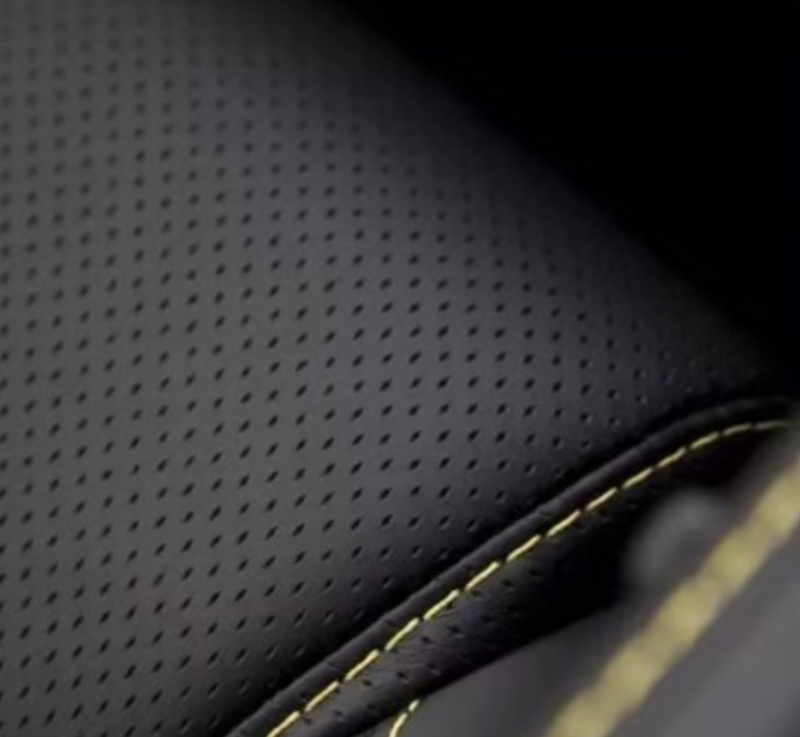


Car seat seat surface decorations are often designed by combining multiple techniques. Different materials require different decorative techniques. For example, genuine leather and fabric fabrics have better breathability and don’t require drilling, whereas genuine leather is very necessary. Of course, this is not absolute; different processes can be combined to create various patterns, patterns, logos, and more. How to integrate the use of leather and other materials and craftsmanship to design seats that combine both appearance and texture?
Drill holes
Seat holes are usually paired with ventilation features, allowing a common technique to punch cross holes, diamond holes, fish scale holes, figure-eight holes, hexagonal holes, perforated plates, long holes, square holes, round holes, perforated plate mesh, triangular holes, and more. These can greatly enhance the texture of the genuine leather, and various patterns can be designed with the holes, such as matching grille styles. Punching patterns can be designed with regular patterns: regular molds punch holes (fewer holes), heavy molds punch holes (many holes).
Alternatively, irregular designs can be used, such as block-shaped distributed punching, which requires CNC programming to control the position, size, and depth of each hole, or use molds to stamp the design pattern in one go.
![Image [1]-Automotive seat cover decoration process: combining perforation, quilting, embroidery, laser carving and embossing for premium designs-Nleather](https://www.nleather.com/wp-content/uploads/2026/06/image-8.png "image – Nleather")
![Image [2]-Automotive seat cover decoration process: combining perforation, quilting, embroidery, laser carving and embossing for premium designs-Nleather](https://www.nleather.com/wp-content/uploads/2026/06/image-7.png "image – Nleather")
Quilting
Quilting originally referred to sewing textile fabric with a layered layer using long needles to secure the cotton and other fillings inside. Nowadays, the manufacturing methods and usage range have changed significantly. Good quilting design also reflects the texture of car seats, with natural bulging formed on the surface and fine folds beneath the stitches creating a beautiful quilting effect. Common quilting methods include geometric quilting, gradient diamond quilting, and backside quilting, which creates a textured surface without visible threads.
![Image [3]-Automotive seat cover decoration process: combining perforation, quilting, embroidery, laser carving and embossing for premium designs-Nleather](https://www.nleather.com/wp-content/uploads/2026/06/image-6.png "image – Nleather")
Seam
A car seat seat cover design contains multiple pieces or even various fabrics, requiring them to be assembled together. Different seaming techniques create different visual effects, and special seaming techniques are also an important part of the design.
![Image [4]-Automotive seat cover decoration process: combining perforation, quilting, embroidery, laser carving and embossing for premium designs-Nleather](https://www.nleather.com/wp-content/uploads/2026/06/image-5.png "image – Nleather")
Embroidery
Embroidery was originally used for decorative items such as clothing, bedding, tablecloths, and stages. It is mostly found on car seats in high-end models. Embroidery accents can enhance the class, often used to display logos, and some high-end custom cars can also be customized with embroidered styles.
![Image [5]-Automotive seat cover decoration process: combining perforation, quilting, embroidery, laser carving and embossing for premium designs-Nleather](https://www.nleather.com/wp-content/uploads/2026/06/image-4.png "image – Nleather")
![Image [6]-Automotive seat cover decoration process: combining perforation, quilting, embroidery, laser carving and embossing for premium designs-Nleather](https://www.nleather.com/wp-content/uploads/2026/06/image-3.png "image – Nleather")
Laser carving
Using high-energy density lasers to locally irradiate the workpiece, causing the surface material to vaporize or undergo chemical reactions that change color, leaving permanent marks. This process does not directly contact the seat surface and can almost freely mark various forms, making it very suitable for engraving logos and other patterns, as well as leather, fabric, artificial leather and other materials.
![Image [7]-Automotive seat cover decoration process: combining perforation, quilting, embroidery, laser carving and embossing for premium designs-Nleather](https://www.nleather.com/wp-content/uploads/2026/06/image-2.png "image – Nleather")
Embossing
Embossing involves pressing various patterns onto the surface of materials under certain temperature and pressure conditions. After pressing, the fabric pattern has a stronger three-dimensional effect and more distinct layering. Embossing can also be used to display brand logos.
![Image [8]-Automotive seat cover decoration process: combining perforation, quilting, embroidery, laser carving and embossing for premium designs-Nleather](https://www.nleather.com/wp-content/uploads/2026/06/image-1.png "image – Nleather")

No comments yet