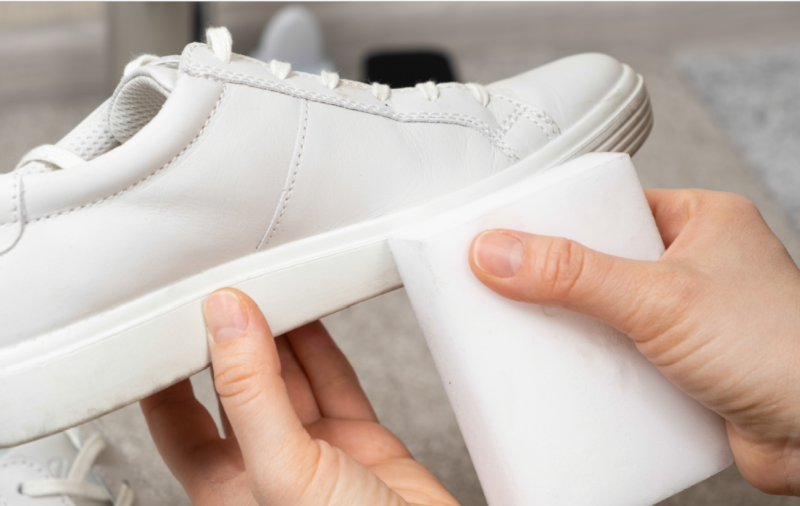


What is the definition of yellowing?
The phenomenon of yellowing under prolonged exposure to natural sunlight or ultraviolet rays, or under the effects of heat, oxygen, stress, trace moisture, impurities, or improper craftsmanship is called yellowing.
Reasons why leather turns yellow
Yellowing of leather is usually caused by factors such as aging, UV exposure, chemical materials, and improper care, which can be alleviated and managed through proper care and cleaning methods.
- Aging phenomenon Leather tends to age over long-term use, and yellowing is an indicator of aging, especially materials like polyurethane (PU) and thermoplastic rubber (TPR), which tend to turn yellow under sunlight.
- Chemical materials : Chemical materials used in tannering, such as glue and dyes, may affect the leather’s lightfastness, leading to yellowing.
- Environmental factors Direct sunlight, humid environments, and high temperatures all accelerate leather yellowing, especially during the southern rainy season when leather is more prone to mold.
- Improper maintenance : If leather products are not kept dry during storage or are exposed to sunlight for extended periods, they will turn yellow
![Image [1]-Leather Yellowing Resistance: Pro Secrets for Stunning Results – Nleather-Nleather](https://www.nleather.com/wp-content/uploads/2026/07/image-63-1024x647.png "image – Nleather")
Why test for yellowing resistance?
Because of the effect of light, there is no permanent pure white in nature, but people generally attribute white to purity, brightness, and the sacred spirit, which led to later things like white paper, white walls, and white shoes. If you can’t make the item white forever, then extend the yellowing period. Therefore, there are two types of tests: A and B to simulate the conditions of sunlight and ultraviolet light.
What is the principle behind yellowing?
Leather yellowing can be divided into immediate yellowing and late yellowing.
Immediate yellowing: After applying white or light-colored leather, after exposure to light and high temperatures, the color change is immediately noticeable and is called immediate yellowing.
Late yellowing: The process in which leather gradually turns yellow due to exposure to light and air oxidation during use. For example, some low-quality indoor white ceilings may yellow, even when exposed to light. Later yellowing is related to the quality of the water mill’s coating materials and also to the context in which the leather is placed.
The yellowing of white and light-colored leathers is not the result of a single factor, but often the combined effect of multiple factors. The most crucial factor is the role of light. Whether polymers age under light and whether molecular chains break depends not only on the wavelength of light but also on the bond energy of the polymer.
![Image [2]-Leather Yellowing Resistance: Pro Secrets for Stunning Results – Nleather-Nleather](https://www.nleather.com/wp-content/uploads/2026/07/image-64.png "image – Nleather")
Yellowing resistance test?
The most commonly used leather methods are Method A and Method B.
Method A: Using a solar lamp and a thermostatic device to simulate a natural environment, the sample is placed in this simulated environment, and after a certain period, the color changes on the sample surface are observed. The light source inside the test chamber is a solar bulb, emitting light similar to sunlight.
Method B: Irradiate the sample with ultraviolet light and observe changes in the color of the sample surface within a specified time. The light source inside the test chamber is a UV lamp, emitting ultraviolet light.
Color difference measurement can be done visually and instrumentally. By visual inspection, it was a gray standard sample card, and the instrument was a colorimeter.
Is the leather coating resistant to yellowing?
There are many materials that affect yellowing due to finishing; today let’s talk about acrylic acid and polyurethane.
Acrylic acid: Acrylic acid synthesis uses certain monomers, such as methyl ester, ethyl ester, butyl ester of acrylic acid, and other vinyl monomers. During use, certain monomers may cause yellow stools. This is because these materials contain unsaturated bonds easily cut by ultraviolet light energy or have substituent structures that are unstable to ultraviolet light. Under the combined action of UV energy, oxygen, and moisture, colored or color-developing groups are formed.
Polyurethane: Leather is often classified by chemical structure into aliphatic and aromatic types. Generally, aliphatic patients have excellent resistance to yellowing. This is because aliphatic polyurethane molecules contain hydrogen atoms at the a- position of the N atom, a structure similar to amides. The cleavage of the N-C or C–0 bonds begins by removing hydrogen atoms to form hydroperoxides. However, aliphatic polyurethane molecules are not reactive enough to carry out the above reactions, so aliphatic polyurethane has good lightfastness and does not yellow.
Leather yellowing resistance is determined by considering both the process and finishing techniques. The yellowing phenomenon is a comprehensive change and requires the complementary coordination of both to extend the yellowing period.
Prevention and treatment methods
- Avoid direct sunlight : When using and storing leather products, try to avoid direct sunlight and keep them in a cool, well-ventilated place.
- Clean regularly : Use a neutral cleaner to regularly wipe the leather surface to keep it clean and prevent dirt buildup that could cause discoloration.
- Use protective agents : Regularly use wax-based care products or specialized leather care products to protect the coating and reduce the risk of yellowing.
- Treat yellowed leather : You can dilute 1.5 liters of tap water with 3 grams of hydrogen peroxide, gently wipe the yellowed leather with a sponge, then spray with warm water and absorb the moisture, repeating this process until the color returns.
- Professional cleaning : If the yellowing is severe, consider sending it to a professional leather care shop for cleaning and dyeing.

No comments yet