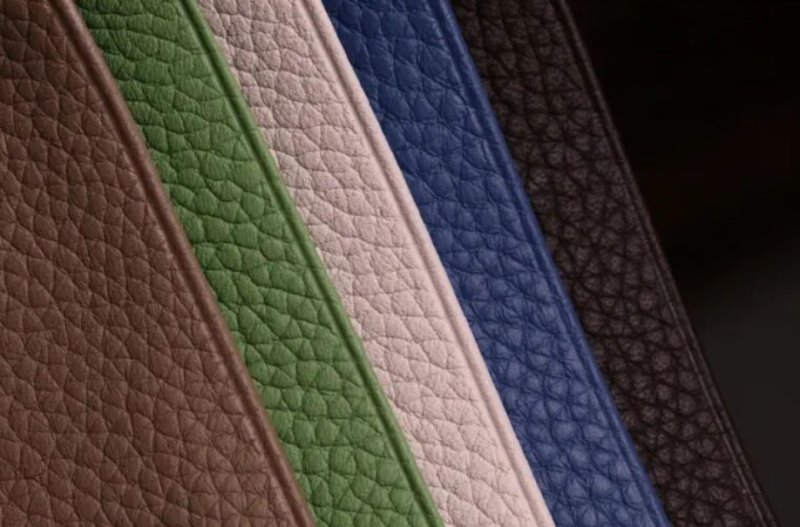


Methods for measuring leather/fur thickness are introduced. Suitable for various types of leather and fur, as well as for measuring the thickness of whole leather and samples. QB/T 2709-2005 and QB/T 1268-2012 use the same instruments and test methods are similar.
![Image [1]-Leather Thickness Measurement: Effortless, Accurate Guide – Nleather-Nleather](https://www.nleather.com/wp-content/uploads/2026/07/image-8.png "image – Nleather")
Terminology (leather, shoe insole size)
Thickness increase rate
After soaking the inner bottom sample in water for 6 hours, the degree of thickness increase and the thickness increase rate are expressed as a percentage.
Dimensional increase rate
After soaking the inner bottom sample in water for 6 hours, the degree of increase in length and width is expressed as a percentage.
Contraction rate
After heating the inner bottom sample in an oven at 35°C for 24 hours, the degree of reduction in length and width is expressed as a percentage.
Dimensional stability
Under specified test conditions (such as temperature and humidity), the rate of change in the distance between two reference points before and after the test, based on the original length, expressed as a percentage.
Testing principle
The thickness gauge measures the thickness of leather, fur, shoe soles, etc. within a specified load and time.
Instruments and equipment
1. The thickness gauge achieves an accuracy of ±0.02 mm throughout its entire range.
![Image [2]-Leather Thickness Measurement: Effortless, Accurate Guide – Nleather-Nleather](https://www.nleather.com/wp-content/uploads/2026/07/image-35.png "image – Nleather")
1.1 Scale gauge, measurement range 0mm~10mm, minimum scale 0.01mm,
1.2 Test bench: a cylindrical body with a horizontal surface, diameter (10.00±0.05) mm, height (3.0±0.1) mm, mounted on a coaxial circular platform surface with a diameter of (50.0±0.2) mm.
Note: A 50mm diameter graphic platform helps support medium-weight fur, preventing protruding surfaces at the presser foot. The test bench protrudes 3mm more than the circular platform, which helps avoid errors caused by uneven surfaces when measuring heavier fur.
1.3 The presser foot is a circular plane with a diameter of (10.00±0.05) mm, coaxial with the test bench, capable of vertical vertical movement. The load generated when the presser foot contacts the test bench surface is (393 ±10) g. The movement distance of the presser foot can be read directly on the scale table.
Note: The load and size of the presser foot form a 49.1 kPa (500g/cm²) Pressure.
1.4 Rigid frame, used to support the scale gauge, test bench, and presser feet.
2. Depilation device (suitable for QB/T1268 fur thickness measurement)
Suitable for removing hairy blankets from samples.
QB/T2709 Steps for measuring leather thickness
1. According to the sample taken according to QB/T 2706-2005, measure the thickness of five points, and make the measurement points cross-shaped.
2. Test the sample, measure the thickness of three points, and the measurement points should be in a straight line at the test site.
3. If the sample cannot be determined at the sampling site, measure the thickness of five points, and the measurement points should be cross-shaped.
4. For hard leather, to avoid bending, it is recommended to take small samples and measure the thickness at three points, making the measurement points straight.
5. For the entire sheet of leather, measure the thickness at five points at each part.
6. Air conditioning of the sample according to QB/T 2707-2005.
7. Place the thickness gauge on a horizontal plane, place the sample particle face face up on the test bench (if the particle face cannot be determined, either side may face up), gently lower the pressor foot, and read and record the reading within 5 ±1 seconds after the pin foot fully contacts the sample.
QB/T1268 Steps for measuring fur thickness
1. Divide the entire fur into three equal parts, and measure 5 points on each equal portion, as shown in Figure .
![Image [3]-Leather Thickness Measurement: Effortless, Accurate Guide – Nleather-Nleather](https://www.nleather.com/wp-content/uploads/2026/07/image-36.png "image – Nleather")
2. For samples whose sampling location cannot be determined, refer to QB/T1267 for sampling, measure the thickness of five points, and make the measurement points cross-shaped.
3. Air conditioning the sample according to the conditions specified in QB/T 1266.
4. Place the thickness gauge on a horizontal plane, place the sample hairline facing up on the test table, gently lower the pressor foot, and after the presser foot is in full contact with the sample for 4~5 seconds, read the reading and record it.
Note: For samples whose test results are related to sample thickness, a depilation device should be used to remove the debrilation before measuring the thickness.
Result Calculation and Evaluation
The result is expressed as an arithmetic average, accurate to 0.01mm.
Relevant testing standards
QB/T 2709-2005 Leather–Physical and mechanical tests-Determination of thickness (Equivalent ISO2589)
ISO 2589:2002,Leather-Physical and mechanical tests-tetermination of thickness, MOD
QB/T 1268-2012 Leather-Physical and mechanical tests-Determination of thickness (Equivalent ISO2589)
GB/T 3903.10-2005/IS0 22651:2002 Footwear-Test methods for insules–Dimensional stability
(ISO 22651:2002,IDT)


No comments yet